WHEEL & TIRE COMPARISON
Compare one wheel and tire combo with another and see exactly how the height, width and backspacing are different.
Enter two wheel-and-tire setups and compare their mounted size, suspension-side clearance, fender position, and height.
JavaScript is required to calculate and draw this comparison. Normal edits stay in your browser; shared-link values are included in the requested URL.
Results update automatically.
Assembly 2 compared with Assembly 1
At a glance
Suspension clearance
—
Toward the fender
—
Mounted width
—
Tire height
—
Theoretical radius
—
Assembly details
Assembly 1
- Wheel / tire
- —
- Tire size
- —
- Wheel size
- —
- Estimated overall wheel width
- —
- Offset
- —
- Backspacing
- —
- Hub face to inner wheel edge
- —
- Hub face to outer wheel edge
- —
- Mounted tire section width
- —
- Tire overall diameter
- —
- Sidewall height
- —
- Maximum assembly width
- —
- Assembly inner edge position
- —
- Assembly outer edge position
- —
- Tire dimension basis
- —
Assembly 2
- Wheel / tire
- —
- Tire size
- —
- Wheel size
- —
- Estimated overall wheel width
- —
- Offset
- —
- Backspacing
- —
- Hub face to inner wheel edge
- —
- Hub face to outer wheel edge
- —
- Mounted tire section width
- —
- Tire overall diameter
- —
- Sidewall height
- —
- Maximum assembly width
- —
- Assembly inner edge position
- —
- Assembly outer edge position
- —
- Tire dimension basis
- —
Radius change is a theoretical unloaded change at the top and bottom of the tire. Actual ride-height change depends on load, inflation, construction, and measured tire dimensions.
If you want to compare two wheels to see how the offset will change their fitment on your vehicle then visit our Wheel Offset Calculator
EXAMPLE: 17×8 +12 vs 17×9 -38
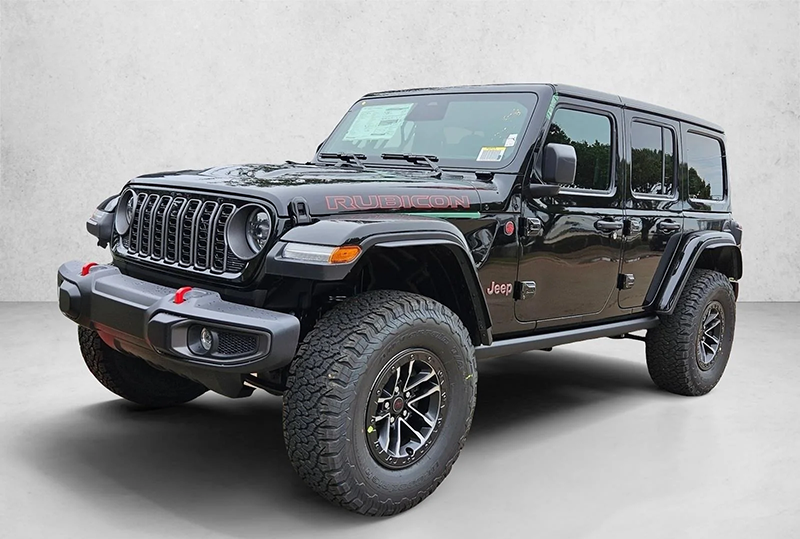
Wheel 1 - Jeep Xtreme 35" Package
Size: 17 × 8
+12 mm offset
Approx. 5.47″ backspacing
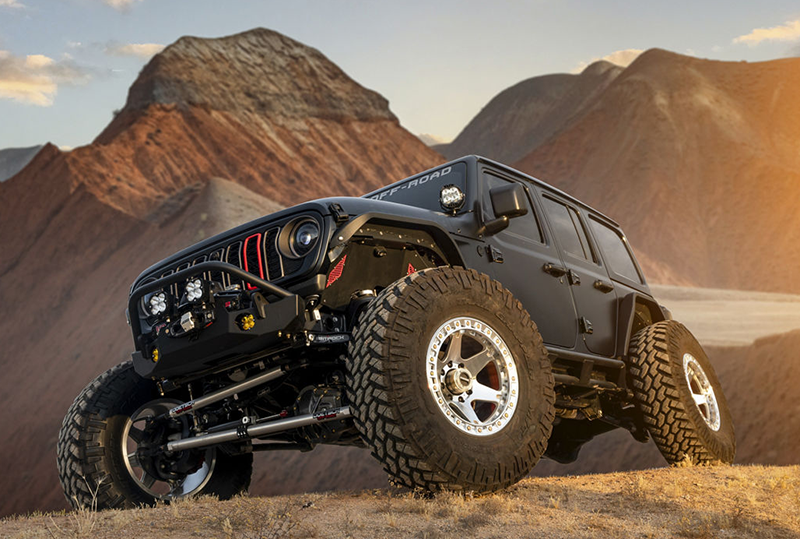
Wheel 2 - KMC 238 17x9 -38
Size: 17 × 9
−38 mm offset
Approx. 3.50″ backspacing
RESULT:
Here’s a real-world example, where you might have bought your Jeep with the factory 17×8 wheels. These come with an offset of +12mm, which tucks the wheel inside the fender.
Later you decide you want to be able to add new suspension and as a result you get more articulation. This means you need to move the wheel and tire away from the body of the Jeep so that it doesn’t rub.
To accomplish this you want to upgrade to a 17×9 wheel. Because the wheel is wider, if it had the same offset then it would probably rub against the spring or the fender well. So to move the wheel out you want to see if a -38 offset will work.
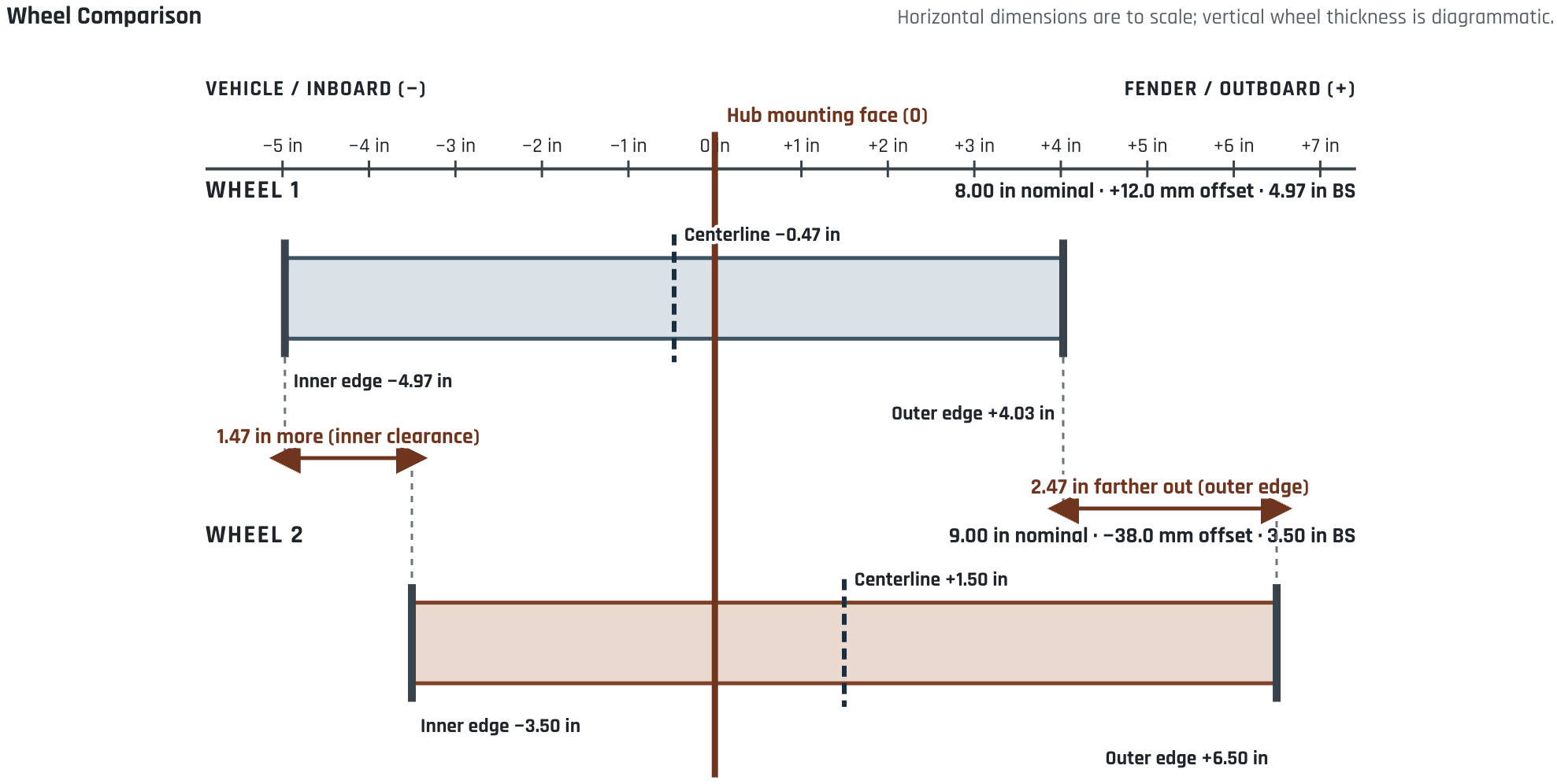
The 17×9 −38 wheel moves approximately:
- 63 mm / 2.48″ farther toward the fender
- 37 mm / 1.46″ farther away from the suspension
The calculator shows that with a -38 offset, even though the wheel is 1 inch wider, it still gives you nearly 1.5 inches of clearance for the wheel well and the suspension components. However, with the added width combined with the more negative offset the wheel will poke out of the fender nearly 2.5 inches more than the stock wheel.
This also means that the total width of the wheels will increase by nearly 5 inches.
WHAT IS WHEEL OFFSET?
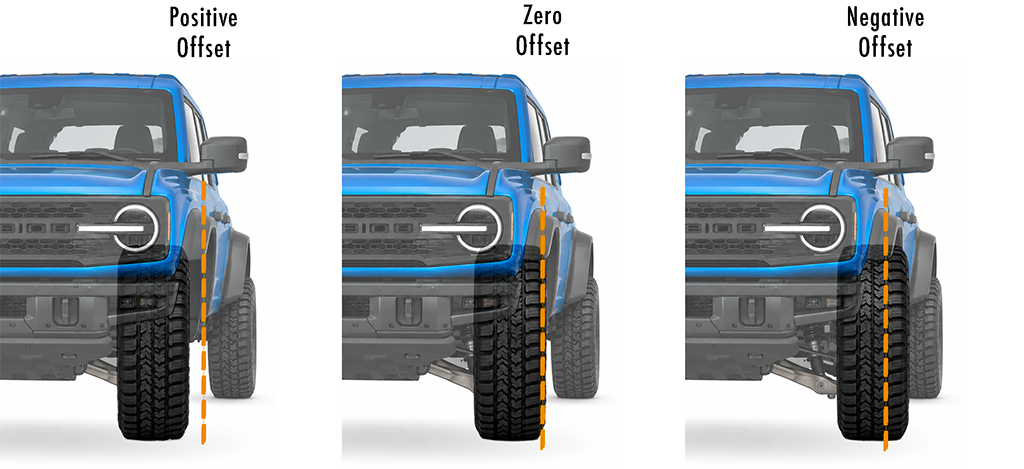
Wheel offset is the distance in millimeters measured between the surface where the wheel mounts to the hub and the centerline of the wheel. Wheel offset is described in the following ways:
Positive Offset
This is where the mounting surface of the wheel is very close to the outer edge of the wheel, tucking the wheel further into the wheel well.
Zero Offset
This is a neutral wheel, where the mounting surface is lined up with the centerline of the wheel.
Negative Offset
A wheel with a negative offset has the mounting surface further away from the outside lip of the wheel, which in-turn means the wheel will poke out further from the wheel well.
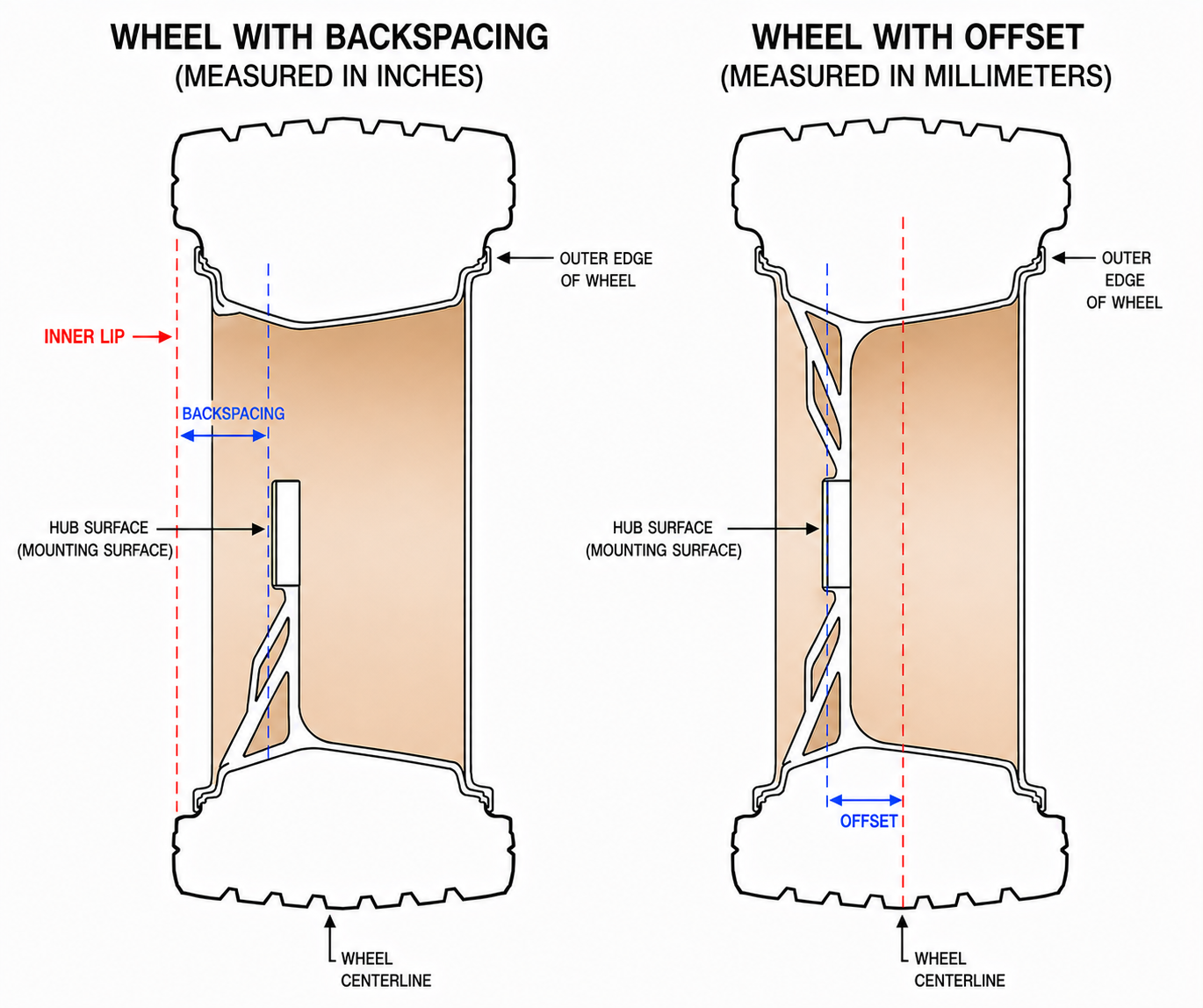
BACKSPACING vs OFFSET
Where wheel offset measures the distance from the hub mounting surface of the wheel to its centerline in millimeters. backspacing measures the distance from the hub mounting surface to the edge of the back lip of the wheel in inches. So offset can be positive or negative, but backspacing can only be a positive number.
Offset to Backspacing Formula
For conventional wheel dimensions:
Backspacing ≈ ((nominal wheel width + 1″) ÷ 2) + (offset ÷ 25.4)
where:
- wheel width is the manufacturer’s nominal bead-seat width
- approximately 1 inch is added for the combined rim flanges
- offset is measured in millimeters
- backspacing is returned in inches
The additional 1 inch is an approximation. Actual overall rim width varies by wheel design, so physical measurements and manufacturer specifications should be used for critical-clearance decisions.
WHY DOES OFFSET MATTER?
The factory wheel and tire package on your vehicle is designed to work with the suspension, steering and brakes. When you want to add new wheels and tires there are some things that you need to consider.
If the wheel you are adding has a more positive offset than your stock wheels it might have problems clearing the brakes, suspension or parts of the body or frame.
A wheel with negative offset might be used to make room for larger brakes or shocks, or to move the wheel and tire further away from the body to provide more clearance when the tire is taller and or the wheel is at full-stuff in the wheel well.
WHAT ABOUT SCRUB RADIUS?
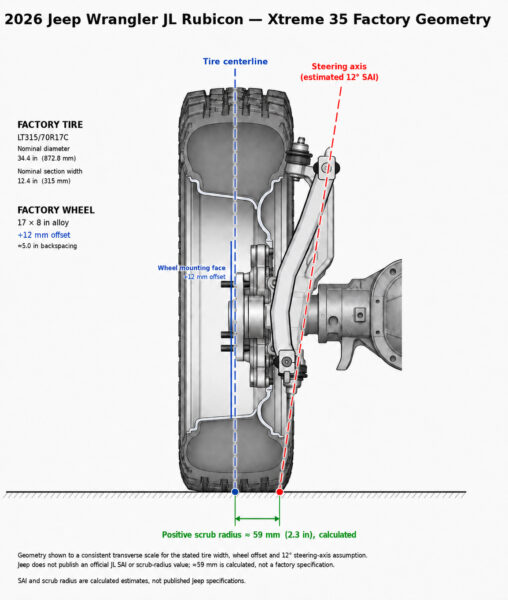
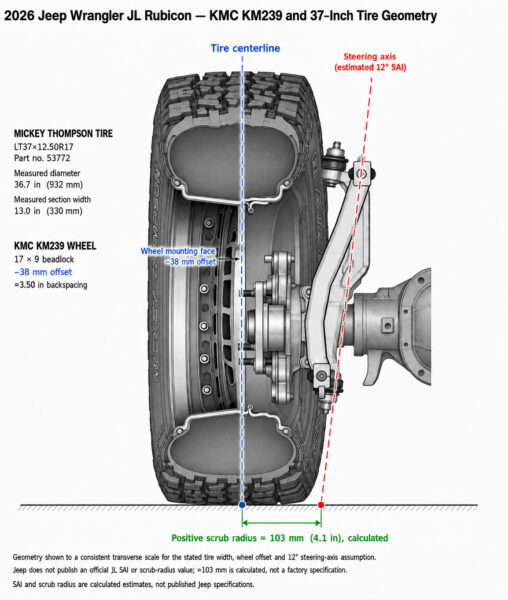
Scrub radius is the distance between where the centerline of the tire and an imaginary line drawn through the pivot points of your ball joints or kingpin (called the steering axis inclination), meet the ground.
Vehicle manufacturers select scrub radius as part of the overall steering and suspension geometry. Changing wheel offset or tire position changes that relationship and can therefore alter steering feel and component loading.
If you were to change your wheels to a negative offset, while keeping the same sized tire, then you are going to increase the scrub radius. This will put extra load on your steering components and it may cause the tire to toe out during heavy braking. It may also make the steering feel more darty and your vehicle may tramline (or get stuck in road grooves) more easily.
Changing tire diameter also changes where the steering axis intersects the road relative to the tire centerline. Depending on the steering-axis angle and wheel position, a taller tire can change scrub radius, but tire diameter alone does not determine whether scrub radius increases or decreases.
Below is an example for a Jeep JL. The picture on the left shows the wheel and tire from the Xtreme 35 package. You can see the scrub radius from the factory is a little over two inches. By comparison the picture on the right shows a 9 inch wide wheel with 3.5 in backspacing, which might be typical for a lifted Jeep. It has a 37 inch tire, so it’s taller, but that doesn’t make up for the difference in backspacing, so the scrub radius is now a little over 4 inches. You might feel this larger scrub radius as different steering characteristics and you will probably want to upgrade to beefier ball joints!
Last reviewed: August 2026